Tuesday, 4 November 2008
Seal at Peacehaven, Sussex
A young seal has been reported off the Sussex coast at Peacehaven. It has been around for a few days.

Wednesday, 22 October 2008
Common Seal Sighting
I received a seal sighting on Monday from John Bradshaw Chairman of the Shoreham Beach LNR Management Group. An adult common seal was hauled out on the bank of the River Adur bank near the airport, at 3.00pm. John went home to get his camera but when he returned the seal was no longer there. However, a passer by said they saw the seal swim further up river. The sighting occurred about an hour before high tide.
This is particularly interesting as seals do not usually seem to swim further up the Adur than the Norfolk bridge (just south of where the seal was spotted). I do however receive reports of seals several miles up the River Ouse and the River Arun as part of my role as Sussex County Recorder for Sea Mammals. Now that common seals are a biodiversity action plan species, sightings are even more important and its always good to receive observations.
This is particularly interesting as seals do not usually seem to swim further up the Adur than the Norfolk bridge (just south of where the seal was spotted). I do however receive reports of seals several miles up the River Ouse and the River Arun as part of my role as Sussex County Recorder for Sea Mammals. Now that common seals are a biodiversity action plan species, sightings are even more important and its always good to receive observations.
Tuesday, 2 September 2008
Wexford Southern Ireland
I have just come back from holiday in Wexford (town) Wexford County in Southern Ireland. As to be expected I saw some fascinating wildlife and thought you might like to see a few pictures.


A sequence of heron pictures. This lone heron was feeding in a small puddle left behind by the receding tide 


Grey seals that come into the harbour and fed scraps by fishermen (Kilmore Quay)
Two cormorants startled from a rest place on the quay

One of the more secluded sandy beaches below. Most of the beaches are long stretches of sand with few people. Many are backed by sand dunes.
Dune insects fighting near a hole (not sure what they are)

Burnet moth

There are lots of sea shells laying on the sand, wexford mussel, razor shells and large otter shells. This shell has a hole made by a predator, probably a neclace shell.

There were many seabirds including several gull species, fulmar, gannets, oystercatchers and terns. The terns were diving for fish, this one was successful.

Thursday, 14 August 2008
Shoreham Beach Marine Week Event
 Last Monday (11th August) I ran an event for the Friends of Shoreham Beach for Marine Week. This was an inter-tidal session on a small beach inside Shoreham Harbour. Protected it makes an idea beach for this type of event, both for the variety of creatures and the safety of the participants.
We found a wide range of animals life including beadlet sea anemones, edible winkle, limpet, dog whelk, numerous shore crabs, sea slater, amphipods, sand mason worms, rag worm, blenny and goby (fish)

Beadlet Anemone

Chiton (or coat-of-mail shell)

Common shore crab
 Goby and juvenile shore crabs
 There were various marine birds such as turnstones, dunlin, cormorant, terns and this egret.
We mingled with the visitors to the events and answered questions ansd pointed out things of interest. We set a few tanks and containers up at the top of the beach to house a few animals temporarily and discussed these before they were retrned to the tide pools. There was a lot of interest and many of the people said they would come back and explore the beach themselves - which is really the main aim of such an event, raising awareness and encouraging people to enguage with their coastline.
Catch Up
Due to the large amount of urban wildlife work I have been doing over the last few months I have rather neglected this blog. So I thought it was time I caught up a bit.
3rd May
A common seal was reported up the Arun River past Amberly castle by the railway crossing.

 The common seal has a definite forehead and is more dog-like in profile than our other UK seal the Grey Seal. The other difference is that the grey seals nostrils are parallel while the common seals are V shaped and with the muzzle look distinctively Y-shaped. We do have a handful of seal sightings upriver each year, usually in the Ouze and the Arun. On the river Adur, the occasional seal visitor seems to be restricted to the estuary region between the harbour mouth and the Toll Bridge.
 While both grey and common seals visit Sussex waters, it is the common seal that is most frequently reported (out of the sightings where a species has been identifiable). Almost all seals that have been specifically identified in upper reaches of these rivers have been common seal.
15 June 2008
15 June 2008
Another seal, probably a common seal, was spotted in the River Adur lower estuary, first of all on the Sussex Wharf side of the river in the early evening from 8:30 pm. It then swam over to the scrapyard side (east of Monteum, where the fishing boats moor up and unload fish) and was seen for 45 minutes chasing after the fish in the river.
Dolphins
Dolphin sightings have been poor this year off Sussex, just a few. We were lucky to get a sighting during National Whale and Dolphin Watch last week in June (the only one for the south coast east of Devon). This was a sighting a sighting of a bottlenose dolphin close to the shore near Shoreham Harbour.
Wednesday, 19 March 2008
Shoreham Beach
Had a look at Shoreham Beach to see if there were many stranded starfish and what else I could find of interest on the strandline.
 There were very few starfish present. Mainly bits of larger ones, especially single legs. There were a quite a few dogfish egg case but only two ray egg cases. Only one of these was intact and possible to identify. It was from an undulate ray. The egg felt heavier than the empty cases and smelt. I carefully cut it open to reveal a partly developed ray with egg yolk. The embryo had started to dry. (see below)
  It was interesting to see the number of pebbles with holes on the beach. It took a lot of searching last month to find a few for a display, today they were everywhere. We now call thgem lucky stones but were originally refered to as hagstones and where reputed to be a protection again witches. Here are just a few of the hagstones I found on a short stretch of beach.
Saturday, 15 March 2008
Beachcombing after the gales
First chance to check out the beach following the severe gales recently. We went to Southwick Beach first starting at Carrots Cafe along to the eastern arm of Shoreham Harbour.

We walked to the end of the harbour arm where a couple of fishing boats chugged along underneath a cloud of seagulls wheeling overhead. Within the harbour mouth a great crested grebe dived periodically beneath the water. Not a common bird in this area but I have noticed reports over the years of Great Crested Grebe on the sea at Shoreham.
 On the way back to the car we explored the strandline. The most common strandline objects were the clumps of whelk eggs. Usually washed ashore after the eggs had hatched, due to the stormy seas some of the egg capsules still had eggs. There were also large piles of slipper limpet shells that had been washed up together. There was also a dead spider crab and numerous dead starfish amoungst the debris.
 There were numerous empty dogfish eggcases and a few ray egg cases (Dogfish egg case below)
 We also found about a dozen scallop shells (below) and several oyster shells, the latter had both halves (valves) still intact.
 Afterwards we drove along the coast to Hove beach for a hot drink and to further explore the strandline. My wife Sharon and our friend Xena had visited this beach yesterday and said there was lots to see.
 There were many slipper limpet shells on this beach as well. I also found a stack of live slipper limpets, 5 stuck together in a stack.
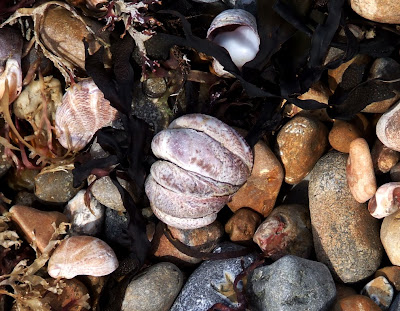 The bottom slipper limpet is a female the rest are males. If the female dies, for example if they are dislodged in a storm, the next male will change sex and become female. Unlike the common limpet, slipper limpets are plankton feeders.
 There were also numerous whelk eggcases here too (see above). A few dogfish eggcases and a larger number of ray eggcases (see below), 14 which I found on just one area of the beach.
 I found the remains of a small sea urchin (below). Not an empty test (this is what the shell is called) unfortuantely but the dead remains with the spines missing. If you look carefully at the image below you will notice the tube worm on the slipper limpet shell, top left.
 The other unusual find was a clump of eggs about 10 cm across. The nearest thing I had seen to this is lumpsucker fish eggs. The female lumpsucker lays her eggs close to shore and leaves them to be guarded by the male.

We walked to the end of the harbour arm where a couple of fishing boats chugged along underneath a cloud of seagulls wheeling overhead. Within the harbour mouth a great crested grebe dived periodically beneath the water. Not a common bird in this area but I have noticed reports over the years of Great Crested Grebe on the sea at Shoreham.
On the way back to the car we explored the strandline. The most common strandline objects were the clumps of whelk eggs. Usually washed ashore after the eggs had hatched, due to the stormy seas some of the egg capsules still had eggs. There were also large piles of slipper limpet shells that had been washed up together. There was also a dead spider crab and numerous dead starfish amoungst the debris. There were numerous empty dogfish eggcases and a few ray egg cases (Dogfish egg case below) We also found about a dozen scallop shells (below) and several oyster shells, the latter had both halves (valves) still intact. Afterwards we drove along the coast to Hove beach for a hot drink and to further explore the strandline. My wife Sharon and our friend Xena had visited this beach yesterday and said there was lots to see.There were many slipper limpet shells on this beach as well. I also found a stack of live slipper limpets, 5 stuck together in a stack.The bottom slipper limpet is a female the rest are males. If the female dies, for example if they are dislodged in a storm, the next male will change sex and become female. Unlike the common limpet, slipper limpets are plankton feeders. There were also numerous whelk eggcases here too (see above). A few dogfish eggcases and a larger number of ray eggcases (see below), 14 which I found on just one area of the beach.I found the remains of a small sea urchin (below). Not an empty test (this is what the shell is called) unfortuantely but the dead remains with the spines missing. If you look carefully at the image below you will notice the tube worm on the slipper limpet shell, top left. The other unusual find was a clump of eggs about 10 cm across. The nearest thing I had seen to this is lumpsucker fish eggs. The female lumpsucker lays her eggs close to shore and leaves them to be guarded by the male.
Subscribe to:
Posts (Atom)

