Showing posts with label Sussex. Show all posts

Monday, 27 February 2017

Seal in the river Ouse

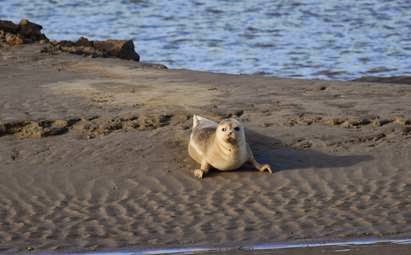
Just received a report of a seal in the river Ouse yesterday morning by the Lewes Railway Land Nature Reserve. Unfortunately photograph is from a distance and not possible to be sure if its a common seal or a grey seal. 


Common seals are seen from time to time in the river Ouse - in fact we have a common seal named 'Lewes' who has been visiting the river Ouse near Lewes for many years now.

However we do also occasionally see grey seal off Sussex and occasionally in our Sussex rivers.

The seal was observed feeding - with  fish in its mouth. Food is one of the attractions that encourages some seals to venture into our rivers in the winter months.

I have tried manipulating this photograph and I think it may be a common seal - but not certain.

For more seal sightings, type 'seal' into the search bar

Sunday, 6 November 2016

Grey seal


Around 3.00 - 3.30pm today, just after high tide, a grey seal was observed off the beach at Aldwick. It was only a few feet off shore and a clear sightings of the head which was dark grey, quite large and stocky and the top of the heard down to the nose was straight so definitely a grey seal.


It stayed at the surface a few feet from the waters edge, facing towards the shore and looking both above and below the surface and would occasionally submerge and then come back up. It would remain in one place for around a minute or 2 before submerging and then appearing about 50m further west, possibly heading back towards Pagham Harbour as the tide went out or the light faded

Wednesday, 16 March 2016

Common seal Rustington


I received a seal sighting today from Jackie and her friend her were walking along beach front at Rustington on the 14th March.
They spotted the seal at 3.00pm and watched the seal for 30 minutes 'bobbing up and down' its head above water.
Jackie sent me a photograph from which it was possible to see it was a common seal. 

Thursday, 10 March 2016

Common dolphin off the coast at Brighton


I received a sighting of a dolphin from Jess and her partner who spotted a dolphin swimming near Brighton's West Pier on Sunday 6th March.

I have since had a further report on 9th March and a photo from BDMLR  that shows it’s a common dolphin – this time breaching out of the water.

Common dolphins are seen occasionally near shore off Sussex but its not as common as its name suggests. BDMLR will be keeping an eye on the situation in case the dolphin needs assistance.

Thursday, 14 January 2016

Common Seal River Adur


Another sighting of the common seal in the River Adur.

This was forwarded by Sam (below is a picture taken by her husband) at 4.00 pm opposite the wooden heron on the sandbank opposite Ricardo' s

Sadly no natural spot pattern marking visible to identify it as an individual.


Wednesday, 13 January 2016

Common Seal in the River Adur


I received a sighting today from Paul. This is the first sighting of the year in Sussex.

The seal was spotted in the river Adur at 10.00am between the A27 bridge and the toll bridge. The seal was hauled out on the mud flats at low tide as the tide was coming back in.


The seal looks to be healthy and at the moment does not appear to be a seal we have seen before, although when they are dry natural makings and identifiable spot patterns are difficult to see.

The seal in the pictures is resting in the 'banana' pose commonly seen with seals.

All photos copyright Paul Loader
You can see more of Paul's great wildlife photographs at  www.flickr.com/mrfurrylover


Monday, 5 October 2015

Dolphins off Brighton


A large pod of bottlenose dolphins, in two groups, one of about 8 the other 10 seen off Brighton 3rd Oct. The group included young dolphins and a large male.

The dolphins were spotted off Brighton Marina, playing in front of and around sailing boats near No. 1 bouy, around mid morning.

This might be the same group of dolphins reported earlier back in August http://sussexmarinejottings.blogspot.co.uk/2015/08/bottlenose-dolphin-herd-off-west-sussex.html


Tuesday, 8 September 2015

Seal sighting off Brighton

I received a seal sighting yesterday at Brighton. The seal was spotted by Jonathan just off the beach  by west pier brighton. The seal slowly swam underwater west along the coast towards Hove surfacing occasionally.


It is not known if this is a common or a grey seal.

Friday, 4 September 2015

Seal obseved Bexhill East Sussex

A seal was reported feeding at Cooden beach at Bexhill (by old flag pole between Cooden Beach Hotel and the Star Inn). The seal was seen feeding and resting. A seal was previously reported feeding near here on 3rd July


Friday, 21 August 2015

More on Sussex dolphin herd

I have just heard today that the dolphin herd I posted on 18th August, seen in West Sussex, were later seen that afternoon (Sunday) at the West Pier Brighton and later at Saltdean near a group of wakeboarders.

Tuesday, 27 January 2015

Probable grey Seal at Hove


Just received an e-mail from SWT Wildcall about a seal off Hove Beach. The attached pic was from a phone and relatively poor quality. My best guess is it could be a grey seal (hard to see from position and quality- if nostrils were visible it would be easier to ID). 
The size and position of the eyes also suggest a grey – but I may be wrong. The picture is very low quality (but as always, better than no picture.


The seal was spotted off Hove seafront at about 7.30 am this morning, by the groyne near Embassy Court/ King Alfred. The observer reported the seal appeared healthy.Unfortunately I was unable to get to the beach in time to take a look.
 

Monday, 5 January 2015

Seal still visiting the River Adur


The common seal is still in the river Adur at Shoreham and I have received many sightings through December, including two sightings on Christmas Day.


I received two separate sightings today of the same seal in the Adur. 


Sunday, 14 December 2014

Common Seal, River Adur West Sussex

I received a sighting from Marie a dog walker along the River Adur in Shoreham-By-Sea on Saturday December 13th 2014. The time was about 16:30. The seal was resting on the river bank near the shoreham bypass bridge.
Even thought it was getting dark, Marie was able to send some photos and even with the low light and  distance from the seal there was a good head silhouette  that identified it as a common seal.
Marie spoke to a fellow dog walker who said that he had observed the seal earlier in the week a couple of times and that on one occasion it was making a barking noise (something I have only head during mating/territorial barking and if feeling threatened.

Friday, 28 June 2013

Small dead shark on Shoreham Beach

I received a call from the local paper to comment on the dried remains of a possible small shark found on Shoreham Beach Local Nature Reserve.
My best identification from the picture was a smooth hound a small bottom living shark. The claspers were visible determine it was  a male.

This also provide a great opportunity to include some much need positive PR for sharks.

Sunday, 9 September 2012

Eastbourne Seal

I received a fascinating seal sighting from Ellie who was kayaking with her family off Seaford beach when a seal swam past about 10 feet from shore, it was heading towards Newhaven way. There were lots of people in the sea but the seal nether showed an interest in them or avoided them. It swam past about 2 feet from Ellie's kayak. The time was about 3.00pm.


She later found out from a friend that she had also seen a seal off Eastbourne Beach which was heading towards Seaford way. This seal was seen about 11.00am. This seal may be the same seal seen in Eastbourne harbour from time to time.

Friday, 31 August 2012

Pevensey seal sighting

A seal was observed today by the freshwater outlet at Pevensey Bay. This was a common seal and probably the one that has been visiting Eastbourne Harbour on and off this summer. The observer also provided an anecdotal sighting of a seal in the same location about a month ago.


Wednesday, 2 November 2011

Grey seal at Goring

I received a grey seal sighting from the Sussex Wildlife Trust 'Wildcall' conservation officer.
The seal was seen at 12.30 pm on Thursday 13th October and is almost certainly the same seal as reported nearby at Goring on 17th October. The seal was about 20 metres from the high tide off the beach at Rustington.

Monday, 18 July 2011

Collecting trip at Kingston Beach Shoreham Harbour

I visited Kingston beach today to collect some marine invertebrates for a school visit on Wednesday. As usual the challenge is to find very small animals that can be shown under the digital microscope.


The beach is inside the harbour mouth at Shoreham which means is is protected from the worst of the weather.

A few shingle plants can be found at the top of the beach such as this sea kale.

Some sandwich turns were sheltering from the wind on the exposed sand.
They can be identified from other terns by the crested black cap, long black beak with a yellow tip and the short black legs 

The low tide exposes a large area of silty sand. The upper area is stabilised by a mussels bed. Pools off sea water are trapped between the gaps providingng temporary pools. 


However beneath this is chalk which shows through in places

I moved a loose piece of chalk and found some live piddock shells. Piddocks bore into the chalk where they can live in relative safety. They feed using long siphons that protrude out of the chalk at high tide. This is the underside.

The old sea defences also provide places for marine life to colonise and also several large pools collect at the base.

These are dog whelk eggs. You can also see a small hole in the mussel shell. Dog whelks feed on mussels by boring a  hole through its shell. You can see the white shell of an adult dog whelk behind the eggs.

The transparent prawns lining in the pool at the base of the sea defence are difficult to spot unless they move.

There were several large snakelock anemones in one of the larger pools

They can be identified by the green tentacles (a symbiotic algae lives in them giving them the colour) with pink tips. Unlike beadlet anemone it cannot close up at low tide.


Check out my next blog entry to find out what sea animals I found to take to the school.

Saturday, 21 May 2011

Exploring vegetated shingle habitat - schools

Today we ran a special course for the Pupil Enrichment Programme - part of West Sussex County Councils Gifted and Talented programme. We were able to use a local school as a base to run the indoor session, looking at the coastal geography (starting from Cretaceous Period) and the fascinating local maritime history.

The indoor session also provided an introduction to the vegetated shingle habitat, the adaptations that allow it to grow in such a harsh environment and the wildlife that the plants attract. This prepared the pupils for the practical work we would do on the beach.

We started with a transect survey, using a tape and canes, and the pupils surveyed the beach in metre squares from the top of the beach to the high tide line.

The pupils also investigated the plants themselves looking for special adaptations and identifying the plants.

Back in the classroom we discussed our findings. We also discussed invasive species, many of which are garden escapees. Due to garden rubbish being dumped on the beach, this is causing the shingle to become more rich in nutrients allowing the invasive species to take over and swamp out some of the vegetated shingle plants.

The main problem species are red valerian and silver ragwort. We counted the number of squares that contained these species. The result was 13 out of 40 squares in one transect and 15 out of 40 squares in the second transect.

In the afternoon session we returned to the beach to record the wildlife that we saw.
There were only a few bird species visible today, house sparrow, starling and carrion crow

We did watch a herring gull repeatedly picking up and dropping a seashell in an attempt to break it open and eat the occupant.
The afternoon was quite sunny and so we saw many wall lizard amongst the vegetation.
It was a bit windy so we did not see many butterflies, mainly white butterflies.
However we did find several caterpillars of the Garden Tiger Moth. These were on several of the silver ragwort.

There were also two types of beetle, this attractive Malachius bipustulus

and this Oedemera nobilis
There were several zebra jumping spiders

One solitary black ant.
Last year I ran a pilot project called Bees on the Beach. The aim of this project was to find out what bee species were present on the beach. Most importantly, to record the plant species that the various bee species pollinated and how this changed at different times of the year.

So we also recorded the bees we saw and the plants that they were visiting. These included a bumble bees and a few honey bees. We saw one solitary bee, Adrena species, and a cuckoo bumble bee that lays its eggs in other bees nests so that they will care for them. The cuckoo bee looks like the queen bee of the species whose nest they lay their eggs in.
Two banded bumble bee on sea kale flowers.

 Red tailed bumble bee on yellow horned poppy

A red tailed bumble bee on thrift

We saw a good variety of invertebrates on the plants. Back in the classroom we discussed what animals we had seen and then finished off with a round up and final questions.