Friday, 16 April 2010

Brighton Sustainability Conference "The Evolving Seas" Day 2

The second day of the conference focused mainly on renewable energy such as offshore wind farms and wave energy. This included a presentation about the planned wind farm off East Sussex. There was also a very interesting talk from Bournemouth council about the artificial reef.

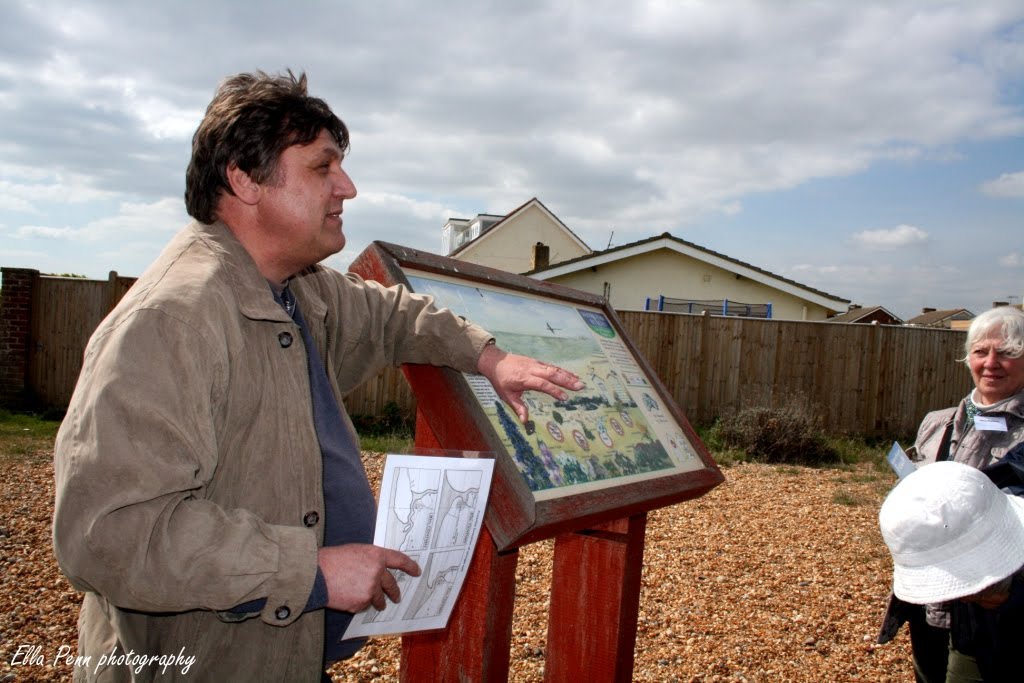
The rest of the day was taken up by the ecology tours the Shoreham Beach Local Nature Reserve. The following is an overview of the tour I led.

Much of Shoreham Beach Local Nature Reserve supports rare vegetated shingle habitat. We knew before hand that the vegetated shingle plants would be less established than usual due to a more severe winter.

A view of the vegetated shingle as it will be in the summer

During the winter months many of the plants die back beneath the shingle and reappear in the spring. This is a useful adaptation to avoid the worst of the winter storms. The sea kale was most evident, but we also saw biting stone crop, bittersweet, curled dock, sea beet, tree mallow and a single yellow horned poppy plant.

Sea Kale

Biting stone crop

Bitter sweet

We looked at some of the features that allow these plants to survive in these harsh conditions. Waxy and hairy leaves to protect them against the drying affect of the sun, wind and sea spray. Long tap roots mean shingle pants to reach freshwater below the shingle and surface roots provide access to the small amount of nutrients near the surface.
Common lizard

As the plants develop they will support a wealth of terrestrial birds and invertebrates. We did see a couple of common lizards scuttling across the shingle.

People often think of shingle as boring old pebbles. They are half right, most of the pebbles are flint which were formed at the same time as chalk – during the Cretaceous period when Sussex was covered by a warm shallow sea.
At the end of the last ice age, melt water scoured the softer chalk, created valleys, and flints and other pebbles were washed down to the coast where they now form shingle beaches. Even the pebbles have a story to tell. The brown flint has been coloured by organic matter before being washed down to the shore. The bigger, greyish flints eroded from the chalk in more recent times. Elongated flints formed in the burrows of burrowing marine life (when the chalk was still soft like clay) some formed around the dead remains of other sea creatures and hide a fossil deep inside. Pebbles with holes were created when flint formed around sponge. We also found some lignite (sea coal) created by the vegetation that grew in the channel when we were still attached to Europe.
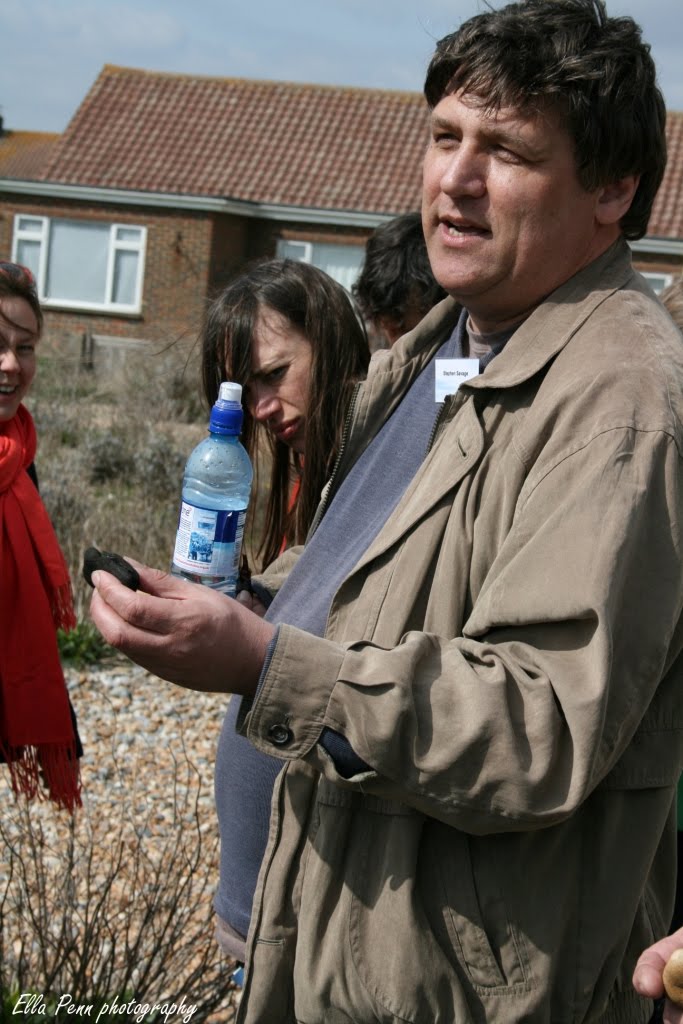
Demonstrating a piece of lignite

Having looked northwards to the South Downs and westward to the chalk cliffs it’s not too much of a surprise to realise that beneath the top layer of shingle is chalk

The beach here is actually quite new in geological terms. Along the Sussex Coast, the waves transport the smaller shingle ever eastwards, this is called longshore drift. With the help of the river Adur, which now runs parallel to the north side of the beach, before entering the sea at the harbour mouth, the Shoreham Beach we know today was created by longshore drift. In fact the Napoleonic fort remains that sit just to the west of the harbour mouth could only be built when the river mouth was stabilized by the first harbour arm built in 1820. Longshore drift constantly blocked the river mouth causing it to find an alternative entrance. Infact the river Adur has entered the sea as far West as Lancing Beach Green and as far east as the Lagoon in Hove. Shoreham has been important for many centuries for ship building (up until Victorian times) and as a Port which is just as important today.


Another fascinating part of the beach is the strandline, made up of seaweed, sea shells, egg cases and all manner of curious objects cast up by the tide – including marine litter.

We found the egg cases of dogfish, ray and whelk. One of the most common shells, the slipper limpet, came across the seas from America on the shells of live oysters planned to re-populate the overfished local oysters. Slipper limpets often live in chains, all males except for the female at the bottom. If the female dies, the next male in line will change sex.

Whelk egg mass and dogfish egg case


Idetifying egg cases

Slipper limpets

Ray egg case

 Sadly, Shoreham Beach is also a good place to illustrate local and global threats. The vegetated shingle plants can be damaged by trampling, bonfires and by people removing the flowers or seeds. A major problem is over enrichment of the shingle caused by dog fouling and garden rubbish. The latter is a major problem as large areas of the shingle have been taken over by invasive species such as red valerian and silver ragwort. These plants can out compete the true vegetated shingle plants. The beach may also be in danger from global problems. Global warming – may cause sea level rise which could eventually flood the plants as they are unable to retreat inland because of coastal squeeze – the plants are tapped between the sea and the houses. More severe storms could also destabilise the shingle and it and the plants could be washed away.

Shoreham beach has a unusual blend of flora and fauna creating a diverse ecology and together with the coastal geography and maritime history, they entwine to tell a fascinating story of this piece of coast. (Also touching on themes discussed in the conference).

I spoke to the delegates briefly on the coach at the end of the ecology walks and they seemed to have enjoyed the afternoon, some mentioned it was a great end to the conference and many said they would return in the summer to see the beach at its best when the shingle plants will be in full flower. I gave each delegate on the tours a copy of the LNR leaflet.

Thursday, 15 April 2010

Brighton Sustainability Conference "The Evolving Seas" Day 1

Here is some general feedback and pictures from the Sustainability Conference “The Evolving Seas” held in Brighton this year by Brighton and Hove Council. On day one, I presented an illustrated presentation about the dynamic and diverse Sussex coastline and the equally diverse local marine ecology. On day two, I ran one of the eco-tours to Shoreham Beach Local Nature Reserve. I also took along a display of my own One World One Ocean.

Day 1
The first day speakers concentrated on issues (in 20 min slots) including spatial planning, the coastal access Bill, Marine Conservation Zones, impact of climate change on our local coastline, coastal erosion and the Brighton Marina. There was also a presentation from the Blue Gym (the original co-founder of surfers against sewage) and my presentation on local marine ecology.

Samples pics and topics from my talk. Some  from my talk

It’s a bit of a challenge to sum up our marine ecology in only 20 minutes and do it justice, so I went for very visual. My PowerPoint presentation consisted of an ariel tour from Bognor in West Sussex to Hastings in East Sussex to illustrate the diversity of Sussex Coastline. At various stages along the way the presentation looked at some examples of marine ecology – Shoreham Beach was one of the stop of places (which also gave a chance to introduce the following days ecology tour on the LNR).

Our diverse coastline
Shoreham Beach LNR
Kingston Beach
Brighton Beach
Rottingdean Beach

The presentation then looked very briefly at offshore marine wildlife, including sea mammals and ended with an overview of the how climate change (and other global issues) might impact on our local marine ecology (using local and global examples).

Common seals
Examples of some of the globaconservation issues

I ended with the One World One Ocean mission statement from my project of the same name (basically illustrating how the oceans are part of our daily lives).

I was pleased to receive some very positive comments, both from the academics and general members of the public who attended.

In between speakers there was a chance to network and look at the various display stands. I also had a stand, One World One Ocean project focusing on the Adventures of Ed the Bear Project http://adventuresofedthebear.blogspot.com/ and other educational projects including the LNR Education Programme.
Me and my display stand

Saturday, 3 April 2010

Dead porpoise River Adur, Shoreham West Sussex

I received a call late Friday evening of a dead dolphin in the river Adur at Shoreham. On close inspection I discovered that it was in fact a harbour porpoise. The porpoise was situated on the rather muddy bank of the river, about 100 metres north of the old Toll Bridge.
While the size and body shape seemed to indicate a harbour porpoise (it was in poor condition) the shape of the teeth confirmed it as a porpoise. Harbour porpoise have spade shaped teeth, rather than the pointed teeth that dolphins have.

I was able to take pics, measurements and remove a tooth and have forwarded the information to the natural history museum who record and study all UK strandings of Cetaceans. The tooth can be used to age the animal, as cetacean teeth have growth rings similar to a tree.

Infact stranded whales and dolphins in England were once classed as "Royal Fish" and were the property of the crown. This has now been taken over by the Natural History Museum of London and it is a legal requirement that all dead strandings are reported to them. There was a very high tide yesterday and the animal may have been swept into the river – however it did appear to be quite fresh (no smell). The tide was rising fast and the animal was soon covered by the river water. A sad end to a beautiful animal

Monday, 22 March 2010

Common Seal River Ouse

A common seal, almost certainly the same seal recorded previously in this river, is back again. The common seal frequently hauls out on a pontoon by the river bank. We do receive occasional seal sightings in local rivers at this time of the year and as usual the seal is fit and healthy.

(c) Trevor Weeks British Divers Marine Life Rescue

Many people are surprised to see this seal, especially as it is over 8 miles from the coast.

Thursday, 25 February 2010

Bringing the seashore into the classroom.

I have been working on an exciting new session for schools this year about tide pool invertebrates. It has been developed inparticular for schools who are unable to take their pupils down to the coast to experience local marine wildlife. This might be because the children are too young or because of the difficulties of getting a class of children to the beach.

By using a digital microscope and media projector, the session takes the form of a living lecture as the class will be able to see live animals projected onto the whiteboard screen. The children can observe sea anemones opening before their eyes, barnacles feeding, crabs scuttling sideways, marine worms, crustaceans and sea snails (depending on specimens collected).

Through first hand observation the children have the opportunity to classify the marine animals and observe how they move. They are encouraged to suggest how each animal is adapted to its habitat and predict what type of food they might eat.

This session allows children to experience the marine life that lives around our coast from the safety of the classroom.
The schools I have worked with on this so far have been primary schools but this would be equally suitable for secondary schools.

Sunday, 31 January 2010

Common Seal at Pagham Harbour

I received another fascinating common seal sighting today, the observer was walking at the Western end of the Pagham Harbour Wall (West Sussex). It was high tide and the seal swam very close to the group of people. The observer, Jacky, said it swam around and it seemed to be frolicking. Then it gazed fixedly at us made movements as if it was going to jump out of the water and attack us and at the last minute swam under and turned away. She said you could almost think it was laughing...

Jacky said it followed us as we turned the corner at the end of the wall and started to walk south then we turned back as the way was blocked by a thorn bush and went inland, so that was the last we saw of it. Jacky remarked that it was a quite fabulous encounter. Jacky spoke to the people at the Pagham Harbour Reserve who told her that they do have one seal in occasionally and it comes they think from a colony at Hayling Island.

From the seal tagging project I was involved in and covered last year in this weblog, we did indeed discover that one of the seals from the Hayling Island group did venture into Pagham Harbour on occasions.

Monday, 4 January 2010

First common seal sighting of 2010

I received a report of a Common Seal from Graham in the River Ouse yesterday (2nd January) at Lewes by the moorings.Graham provided the following superb pictures of the seal.

(c) Graham Farey


(c) Graham Farey

The seal was sunning itself on a pontoon and was seen by many people, two sightings reported to me so far.


(c) Graham Farey


(c) Graham Farey

The Ouse is quite a tidal river and it is likely that the seal travelled up river following fish. The tide had recently turned, and the seal may have swum up-river on the incoming tide. Because seals can happily haul out, they sometimes spend a few days up river before returning to the sea. As you will see from my other blog entries, it is not uncommon for healthy "happy" seals to swim upriver.

  (c) Graham Farey

Due to the quality of the pictures I am hoping that we will either be able to match it with a known seal (by spot pattern markings) or create this seal with its own ID profile. There are similarities with a seal observed last year which I intend to investigate further. Watch this space for an update.