Wednesday, 20 July 2011

Learning about inter-tidal invertebrates

School visit today with the live marine invertebrates I collected yesterday. I would be working with one class year groups year 5 and 6. This visit was part of a larger project that the children were studying called "Oceans Alive" and would provide a local context to the Great Barrier Reef which the children had been learning about.
We started with an introduction to the nature reserve and about how the local coastline was formed.
I also included pictures and information about the beach and tide pools the invertebrates were collected from to set the scene.

Then I worked with each year group separately, observing and discussing the live animals as I demonstrated them one at a time.
I put each invertebrate one at a time underneath the video microscope and the image was projected onto a large screen.
The beadlet anemones are always popular. I put them under while they are closed and then add sea water and they open up. This is how they survive in-between the tides.

We spoke about how they catch their food – which I demonstrated with a piece of food I placed in the tentacles. The anemone reacted immediate firing thousands of stinging cells to paralyze its prey. Without eyes it reacts this way to anything that touches its tentacle, even us but our skin is too thick to harm us.

I demonstrated four crustaceans.
I started with an amphipod and we discussed its body type, where it lives, its senses and what it feds on.

Next the shore crab with its armored shell with jointed limbs like a suit of armour.
The children discussed what they thought the crab might eat and I gave it a small piece of seafood which it held in its pincers and it proceeded to shed into smaller pieces. Shore crabs shed their protective shell when they grow but this also gives them the ability to re-grow a lost limb.
Juvenile shore crabs often have markings that help them to camouflage with their surrounding. This one has white blotches that match the pebbles.
I don’t usually take prawns into schools but as it was a very local school this was not a problem. Being transparent means it is camouflaged where ever it is and you can see some of its internal organs such as the brain.
It picks up bits of food with its delicate pincers and constantly sweeps its surroundings with its long antennae.

A surprise crustacean is the barnacle.
Although it looks like a molluscs, the barnacle spends a moth as a free swimming larvae living in the plankton before it changes shape and sticks itself to a suitable hard surface, a rock a sea defense or even another animal in this case a mussel.

Once secured to the rock it cannot move around. It lives by catching food with its feet (once used for swimming).

I also demonstrated some tiny copepods, no bigger than a large sand grain, these are part of the zoo plankton.


I brought several molluscs, one clam was too big so I kept it in a container.
You can see the siphons used to suck water and food into the shell, the food is filtered out and the water passes over the gills so it feed and respires at the same time.
You can also see the large fleshy foot that is used for burrowing in the sand.

Cockles are small enough to show under the microscope and like the clam they burrow in sand and silt
I also showed a piddock which came from the chalk. The piddock burrows into the chalk by rotating its shell.
Safe inside its burrow the piddock can extend its siphon to feed while still protected by the chalk.

This was a lucky find, a loose piece of chalk and a piddock protruding from the bottom. (When finished I carefully put it back into its burrow.

This mussel has attached itself to the Petri dish by strong threads called byssus which the mussel uses to attach itself to rocks and man-made structures.
On this mussel you can clearly see its foot which is not usually visible.

Edible periwinkle glide along on their foot, this is a gastropod as it only has one shell.
All the above molluscs are bivalves as they have two halves to their shell.

Last of all I showed a small rock pool fish, a blenny.
Like the prawn, I don’t usually take a fish to schools but being very close this was not a problem. This juvenile has extra large pectoral fins making it look like a flying fish.
This small fish can even survive out of the water at low tide as long as it is hidden somewhere cool and damp.

Monday, 18 July 2011

Collecting trip at Kingston Beach Shoreham Harbour

I visited Kingston beach today to collect some marine invertebrates for a school visit on Wednesday. As usual the challenge is to find very small animals that can be shown under the digital microscope.

The beach is inside the harbour mouth at Shoreham which means is is protected from the worst of the weather.

A few shingle plants can be found at the top of the beach such as this sea kale.

Some sandwich turns were sheltering from the wind on the exposed sand.
They can be identified from other terns by the crested black cap, long black beak with a yellow tip and the short black legs 

The low tide exposes a large area of silty sand. The upper area is stabilised by a mussels bed. Pools off sea water are trapped between the gaps providingng temporary pools. 


However beneath this is chalk which shows through in places

I moved a loose piece of chalk and found some live piddock shells. Piddocks bore into the chalk where they can live in relative safety. They feed using long siphons that protrude out of the chalk at high tide. This is the underside.

The old sea defences also provide places for marine life to colonise and also several large pools collect at the base.

These are dog whelk eggs. You can also see a small hole in the mussel shell. Dog whelks feed on mussels by boring a  hole through its shell. You can see the white shell of an adult dog whelk behind the eggs.

The transparent prawns lining in the pool at the base of the sea defence are difficult to spot unless they move.

There were several large snakelock anemones in one of the larger pools

They can be identified by the green tentacles (a symbiotic algae lives in them giving them the colour) with pink tips. Unlike beadlet anemone it cannot close up at low tide.


Check out my next blog entry to find out what sea animals I found to take to the school.

Thursday, 7 July 2011

Seal sighting Brighton Marina

Another seal sighting off the Marina at Brighton. The seal was spotted at 9.00am surfers who were surfing off the eastern side of the marina. They reported the seal as being  very curious, which suggests it could possible be Twinkle.

However, over the years I have received several calls where other common seals have approached swimmers and touched them with their whiskers, so of course we can’t be sure if this is Twinkle or not.

Friday, 17 June 2011

Another seal sighting Brighton

Another seal sighting. It was spotted very close to shore, possibly within 10m, by workers on the Brighton Pier. The seal, first seen at 11.15am kept looking at the beach but was also slowly moving west.

Based on previous sighting records, these current sightings over the last few days do suggest that they are one seal and possibly Twinkle.

Tuesday, 14 June 2011

Another seal sighting

Another seal report. This is very close to the seal sighting on 12th June, so it may be the same seal. The seal was seen at  9pm and it was about 50 yards from the shore, east of the pier in front of the Volks railway. The observer, Peter, saw the seal pop up 4 or 5 times looking around. Peter left the beach around 9.30 and the seal was still there. It was almost a full moon so it was easy to spot.

Sunday, 12 June 2011

Seal off Brighton

A common seal was reported yesterday about 20m from the shore at Brighton. It was observed between the nudist beach and the halfway stop for the Volks Railway. The seal stayed in the same general area disappearing underwater and popping its head back up again.

This could be the rescued and released seal Twinkle whose movements we have been following since November 2010. Twinkle does come very close to shore and always appears to be interested in people on the beach or river bank when he swims up stream.

Of course there is no way to be sure without a photograph (I have been able to recognise this seal from face markings in some close up photographs, even when the tag has not been visible) or seeing the tag which is only visible when it is on land.

If you are new to this blog, there are many earlier entries about Twinkle and reports of other seals and dolphins we see off the coast locally.


I was at World Oceans Day with a couple of displays yesterday in Shoreham so I did not see the seal myself this time.

Saturday, 11 June 2011

Adur World Oceans Day Festival and Spring Watch Festival Brighton

We attended the Adur World Oceans Day events again this year. Situated on Coronation Green, next to the high street and River Adur this is a great event at a perfect location.

The weather stayed nice and we were busy all day. Our display focused on two projects.

Project One
Our life sized inflatable bottlenose dolphin was the focus for a display about local dolphin and seal sightings, many of which have been reported on on this weblog.


We were also able to promote an exciting event coming up in November called WhaleFest 2011 organised by Planet Whale. More information about this event will be posted nearer the time. You can also find out more about whale planet at  http://planetwhale.com/

Project Two
I also took along my schools program called One World One Ocean the Adventures of Ed the Bear.


This programme shows how we are all part of one ocean, a celebration of marine biodiversity locally and globally, highlight threats to the oceans, people around the who are helping the oceans and how we can all help the oceans, even by making small changes to our life style.
You can find out more about this project at http://adventuresofedthebear.blogspot.com/


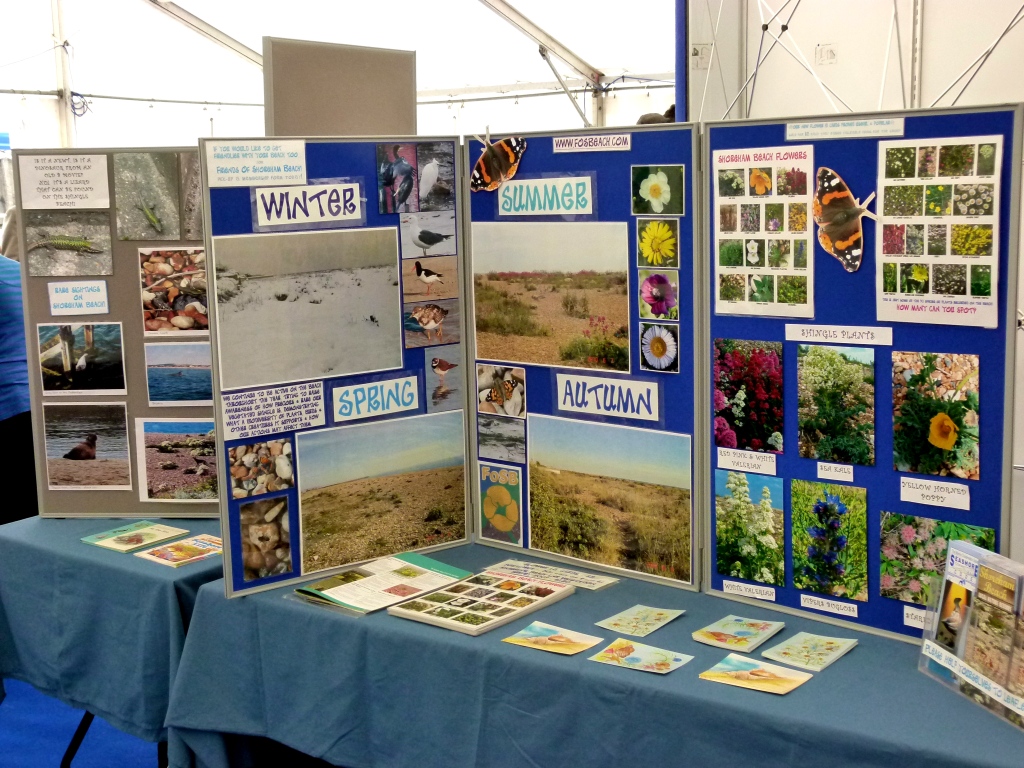
The Friends of Shoreham Beach were also here with a bright and informative display and they were also busy all day with children art activities. You can find out more about the beach and special walks, talks and other event they run, including school visits at http://www.fosbeach.com/
 
The previous Sunday we were also at the Brighton Springwatch Festival at Stanmar Park. I took both of the projects mentioned above.
 
Despite the rain it was well attended and we spoke to make interested visitors