Another seal sighting. It was spotted very close to shore, possibly within 10m, by workers on the Brighton Pier. The seal, first seen at 11.15am kept looking at the beach but was also slowly moving west.
Based on previous sighting records, these current sightings over the last few days do suggest that they are one seal and possibly Twinkle.
Friday, 17 June 2011

Tuesday, 14 June 2011
Another seal sighting
Another seal report. This is very close to the seal sighting on 12th June, so it may be the same seal. The seal was seen at 9pm and it was about 50 yards from the shore, east of the pier in front of the Volks railway. The observer, Peter, saw the seal pop up 4 or 5 times looking around. Peter left the beach around 9.30 and the seal was still there. It was almost a full moon so it was easy to spot.
Sunday, 12 June 2011
Seal off Brighton
A common seal was reported yesterday about 20m from the shore at Brighton. It was observed between the nudist beach and the halfway stop for the Volks Railway. The seal stayed in the same general area disappearing underwater and popping its head back up again.
This could be the rescued and released seal Twinkle whose movements we have been following since November 2010. Twinkle does come very close to shore and always appears to be interested in people on the beach or river bank when he swims up stream.
Of course there is no way to be sure without a photograph (I have been able to recognise this seal from face markings in some close up photographs, even when the tag has not been visible) or seeing the tag which is only visible when it is on land.
If you are new to this blog, there are many earlier entries about Twinkle and reports of other seals and dolphins we see off the coast locally.
I was at World Oceans Day with a couple of displays yesterday in Shoreham so I did not see the seal myself this time.
This could be the rescued and released seal Twinkle whose movements we have been following since November 2010. Twinkle does come very close to shore and always appears to be interested in people on the beach or river bank when he swims up stream.
Of course there is no way to be sure without a photograph (I have been able to recognise this seal from face markings in some close up photographs, even when the tag has not been visible) or seeing the tag which is only visible when it is on land.
If you are new to this blog, there are many earlier entries about Twinkle and reports of other seals and dolphins we see off the coast locally.
I was at World Oceans Day with a couple of displays yesterday in Shoreham so I did not see the seal myself this time.
Saturday, 11 June 2011
Adur World Oceans Day Festival and Spring Watch Festival Brighton
We attended the Adur World Oceans Day events again this year. Situated on Coronation Green, next to the high street and River Adur this is a great event at a perfect location.
The weather stayed nice and we were busy all day. Our display focused on two projects.
Project One
Our life sized inflatable bottlenose dolphin was the focus for a display about local dolphin and seal sightings, many of which have been reported on on this weblog.


The Friends of Shoreham Beach were also here with a bright and informative display and they were also busy all day with children art activities. You can find out more about the beach and special walks, talks and other event they run, including school visits at http://www.fosbeach.com/
The previous Sunday we were also at the Brighton Springwatch Festival at Stanmar Park. I took both of the projects mentioned above.
 Despite the rain it was well attended and we spoke to make interested visitors
The weather stayed nice and we were busy all day. Our display focused on two projects.
Project One
Our life sized inflatable bottlenose dolphin was the focus for a display about local dolphin and seal sightings, many of which have been reported on on this weblog.


We were also able to promote an exciting event coming up in November called WhaleFest 2011 organised by Planet Whale. More information about this event will be posted nearer the time. You can also find out more about whale planet at http://planetwhale.com/
Project Two
I also took along my schools program called One World One Ocean the Adventures of Ed the Bear.


This programme shows how we are all part of one ocean, a celebration of marine biodiversity locally and globally, highlight threats to the oceans, people around the who are helping the oceans and how we can all help the oceans, even by making small changes to our life style.

You can find out more about this project at http://adventuresofedthebear.blogspot.com/
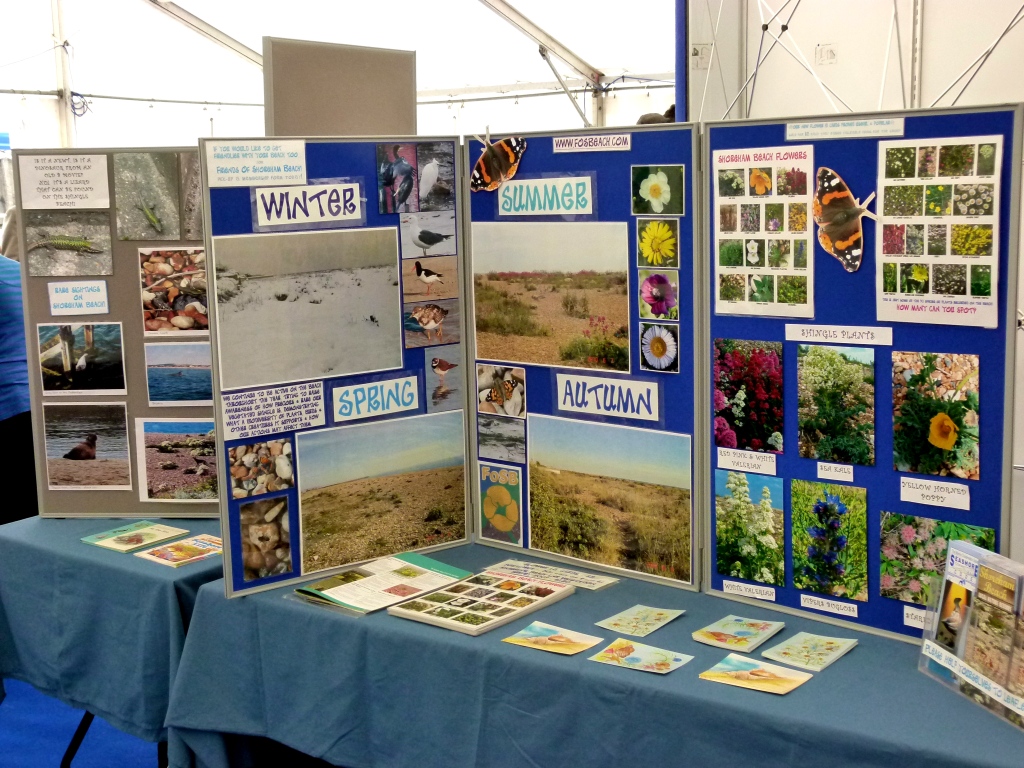
The Friends of Shoreham Beach were also here with a bright and informative display and they were also busy all day with children art activities. You can find out more about the beach and special walks, talks and other event they run, including school visits at http://www.fosbeach.com/
The previous Sunday we were also at the Brighton Springwatch Festival at Stanmar Park. I took both of the projects mentioned above.

Saturday, 21 May 2011
Exploring vegetated shingle habitat - schools
Today we ran a special course for the Pupil Enrichment Programme - part of West Sussex County Councils Gifted and Talented programme. We were able to use a local school as a base to run the indoor session, looking at the coastal geography (starting from Cretaceous Period) and the fascinating local maritime history.

 We started with a transect survey, using a tape and canes, and the pupils surveyed the beach in metre squares from the top of the beach to the high tide line.

 There were only a few bird species visible today, house sparrow, starling and carrion crow


 Last year I ran a pilot project called Bees on the Beach. The aim of this project was to find out what bee species were present on the beach. Most importantly, to record the plant species that the various bee species pollinated and how this changed at different times of the year.

The indoor session also provided an introduction to the vegetated shingle habitat, the adaptations that allow it to grow in such a harsh environment and the wildlife that the plants attract. This prepared the pupils for the practical work we would do on the beach.


The pupils also investigated the plants themselves looking for special adaptations and identifying the plants.

Back in the classroom we discussed our findings. We also discussed invasive species, many of which are garden escapees. Due to garden rubbish being dumped on the beach, this is causing the shingle to become more rich in nutrients allowing the invasive species to take over and swamp out some of the vegetated shingle plants.
The main problem species are red valerian and silver ragwort. We counted the number of squares that contained these species. The result was 13 out of 40 squares in one transect and 15 out of 40 squares in the second transect.

The main problem species are red valerian and silver ragwort. We counted the number of squares that contained these species. The result was 13 out of 40 squares in one transect and 15 out of 40 squares in the second transect.
In the afternoon session we returned to the beach to record the wildlife that we saw.


We did watch a herring gull repeatedly picking up and dropping a seashell in an attempt to break it open and eat the occupant.

The afternoon was quite sunny and so we saw many wall lizard amongst the vegetation.
It was a bit windy so we did not see many butterflies, mainly white butterflies.

However we did find several caterpillars of the Garden Tiger Moth. These were on several of the silver ragwort.
There were also two types of beetle, this attractive Malachius bipustulus


and this Oedemera nobilis

There were several zebra jumping spiders

One solitary black ant.
So we also recorded the bees we saw and the plants that they were visiting. These included a bumble bees and a few honey bees. We saw one solitary bee, Adrena species, and a cuckoo bumble bee that lays its eggs in other bees nests so that they will care for them. The cuckoo bee looks like the queen bee of the species whose nest they lay their eggs in.
 Two banded bumble bee on sea kale flowers.
 Red tailed bumble bee on yellow horned poppy


A red tailed bumble bee on thrift
We saw a good variety of invertebrates on the plants. Back in the classroom we discussed what animals we had seen and then finished off with a round up and final questions.
Monday, 16 May 2011
Two seal sightings
A seal was reported 10 metres off the beach at Hove at about 11:30am on the 9th of April. About 5 people saw the seal, which they were surprised to see. It poked its head out of the water and looked at them for about a minute, then swam off.
Another seal sighting, possibly the same seal, was reported off the same beach on 16th May at 10.00 am. The seal was about 50m from the shore and heading east. These were probably common seals. The observer said that the seal looked like a dog swimming, which also indicates a common seal.
Another seal sighting, possibly the same seal, was reported off the same beach on 16th May at 10.00 am. The seal was about 50m from the shore and heading east. These were probably common seals. The observer said that the seal looked like a dog swimming, which also indicates a common seal.
Sunday, 1 May 2011
Bottlenose dolphins Shoreham
Another bottlenose dolphin sightings, 2 poss, 3 dolphins seen during the Sussex Yacht Regatta on Monday 1st May. The sighting occurred about 250m south of Shoreham harbour at about 10.00am.


One of the photographs shows some good identification marks on the dorsal fin. It would be great to get pics of the dorsal fins of other dolphins from this group.
 It may be possible that there were more dolphins not seen because the observers were taking part in the regatta - possible another sighting of the group reported in the two previous messages.

All the dolphins played around the yachts for about 20 minutes.

One of the photographs shows some good identification marks on the dorsal fin. It would be great to get pics of the dorsal fins of other dolphins from this group.

Subscribe to:
Posts (Atom)

