First chance to check out the beach following the severe gales recently. We went to
Southwick Beach first starting at Carrots Cafe along to the eastern arm of
Shoreham Harbour.

We walked to the end of the harbour arm where a
couple of fishing boats chugged along underneath a cloud of seagulls wheeling overhead. Within the harbour mouth a great crested grebe dived periodically beneath the water. Not a common bird in this area but I have noticed reports over the years of Great Crested Grebe on the sea at Shoreham.

On the way back to the car we explored the strandline. The most common strandline objects were the clumps of whelk eggs. Usually washed ashore after the eggs had hatched, due to the stormy seas some of the egg capsules still had eggs. There were also large piles of slipper limpet shells that had been washed up together. There was also a dead spider crab and numerous dead starfish amoungst the debris.

There were numerous empty dogfish eggcases and a few ray egg cases (Dogfish egg case below)

We also found about a dozen scallop shells (below) and several oyster shells, the latter had both halves (valves) still intact.

Afterwards we drove along the coast to Hove beach for a hot drink and to further explore the strandline. My wife Sharon and our friend Xena had visited this beach yesterday and said there was lots to see.

There were many slipper limpet shells on this beach as well. I also found a stack of live slipper limpets, 5 stuck together in a stack.
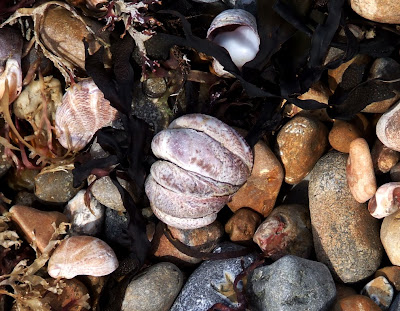
The bottom slipper limpet is a female the rest are males. If the female dies, for example if they are dislodged in a storm, the next male will change sex and become female. Unlike the common limpet, slipper limpets are plankton feeders.

There were also numerous whelk eggcases here too (see above). A few dogfish eggcases and a larger number of ray eggcases (see below), 14 which I found on just one area of the beach.

I found the remains of a small sea urchin (below). Not an empty test (this is what the shell is called) unfortuantely but the dead remains with the spines missing. If you look carefully at the image below you will notice the tube worm on the slipper limpet shell, top left.

The other unusual find was a clump of eggs about 10 cm across. The nearest thing I had seen to this is lumpsucker fish eggs. The female lumpsucker lays her eggs close to shore and leaves them to be guarded by the male.


 Goby and juvenile shore crabs
 There were various marine birds such as turnstones, dunlin, cormorant, terns and this egret.

 The common seal has a definite forehead and is more dog-like in profile than our other UK seal the Grey Seal. The other difference is that the grey seals nostrils are parallel while the common seals are V shaped and with the muzzle look distinctively Y-shaped. We do have a handful of seal sightings upriver each year, usually in the Ouze and the Arun. On the river Adur, the occasional seal visitor seems to be restricted to the estuary region between the harbour mouth and the Toll Bridge.
  There were very few starfish present. Mainly bits of larger ones, especially single legs. There were a quite a few dogfish
  It was interesting to see the number of pebbles with holes on the beach. It took a lot of searching last month to find a few for a display, today they were everywhere. We now call thgem lucky stones but were originally refered to as hagstones and where reputed to be a protection again witches. Here are just a few of the hagstones I found on a short stretch of beach.
 The FoSB display also included an exhibit about marine litter. This consisted of a variety of litter items cast ashore by the tide which were tied to a piece of fishing net (also marine litter). Each label had a tag with information about how long it takes each item to biodegrade.
 This looked at how the local coastline was formed and how it is shapeed by natural forces. This included how chalk and flint were formed and how the shingle beaches contain flint scoured from the chalk and deposited on the coast after the last ice age. Some are the result of more recent coastal erosion. The display also looked at vegeated shingle; the animals that are attacted by this habitat, how the plants have adapted to live in this harsh environment and the threats this habitat faces. These was also information about strandline objects and some examples that could be handled.
 The remainder of the display looked at the science of studying dolphins and whales focusing on photo-identification (recognising individual whales or dolphins) , DNA sampling and satellite tagging whales to study migrations and populations. We also displayed a dolphin skull, sperm whale tooth, baleen killer whale vwertebrae (all on loan from the local Booth Museum of Natural History in Brighton. The event was well attended and there was a lot of interest and divese questions.
 On the mud flats on the far side of the river there were several redshank feeding. Redshark have relatively long legs and stride over the soft mud probbing every now and then with their long beaks. The display will be mainly about the Shoreham Beach Local Nature Reserve and will also be run by the Friends of Shoreham Beach (FoSB).


